"A lot of our current pipeline traces back to conversations at BestPractice.Club where we've been able to help people think through their decisions, building trust through regular touchpoints."
- Tim Richardson, CEO, Iter Consulting
You connected with someone at an event, on a call, or through a referral. The conversation was good, the timing felt right, there was genuine interest. Then nothing happened.
But not because they lost interest. More often it's because it's not clear what to do next or the internal conditions don't yet exist to make this worth the effort and professional risk to champion. When lack of bandwidth is the new normal, the safest and even logical choice is often to wait until there's a "burning platform" or internal mandate.
BestPractice.Club helps that project leader to take the next step. By connecting them with fellow practitioners who are tackling similar challenges in similar contexts - or have experience of doing so - they build confidence in their own read of the situation and lead the critical stakeholder conversations that are necessary for progress to be made... and succeed.
Solution providers are an important part of that process where their expertise and experience is genuinely relevant. Our in-person meetings and online sessions offer no-pitch formats where you work through challenges together, rather than perpetuating a "me vendor, you prospect" dynamic. Engagements are designed as multi-step, starting from today's urgent challenges and, from there, exploring the deeper diagnosis and best-fit solution.
These are the decisions BPC members are working through. Each pattern is drawn from many recorded conversations with practitioners — what goes wrong, what conditions tend to produce better outcomes, and where an outside perspective makes the most difference. If these sound like the organisations you're trying to reach, you're in the right place.
BestPractice.Club works across four decision stages. At each one, a sponsor's contribution looks different — and the value it creates for the practitioner, and for you, is different too.
ORIENT
Is this the right problem to be solving? Your pattern recognition from working across many organisations helps practitioners name the real issue before they commit to a direction.
TEST ASSUMPTIONS
Is their read of the situation accurate? Your honest challenge at this stage prevents the wrong diagnosis from hardening into an RFP.
BUILD CONFIDENCE
Have they genuinely aligned internally, or just avoided the difficult conversations? Sponsors who help practitioners build their internal case here earn the trust that converts later.
COMMIT AND SELECT
Is this plan ready to survive commercial scrutiny? By this stage, practitioners who have been through BestPractice.Club's format arrive as better-prepared clients.
The patterns above are consolidated from many recorded practitioner conversations over the last five years, reviewed alongside conversations with the solution providers who work in this space. The full evidence base and analytical framework is on the BestPractice.Club homepage.
BestPractice.Club is a structured progression. Practitioners move through it as their decision develops — from early orientation through to peer-validated commitment. At each stage, they encounter your expertise in a different way. The format is designed so that by the time a practitioner is ready to engage commercially, they have already stress-tested their thinking, built internal alignment, and understood what good looks like. That makes the commercial conversation a different one.
Here is how each format works for your prospects — and what it creates for you.
Signals keeps practitioners oriented between sessions — a curated feed of supply chain news, organised by topic. It keeps the problems they are working through visible and connected to what is happening in the market. For you: low-friction ongoing awareness with practitioners who are actively thinking about the areas where you work.
Perspectives build the knowledge base. Longer-form insights from practitioners, consultants and solution providers — organised by decision stage, capability area and maturity. Sponsors can contribute Perspectives articles, which means your expertise reaches practitioners during their research phase, before any direct commercial conversation.
Patterns consolidate the practitioner evidence into decision-stage intelligence. Where enough practitioner conversations have accumulated around a specific challenge, they surface as a Pattern — what typically goes wrong, what tends to work, and what conditions produce better outcomes. Pattern pages are where practitioners go when they are ready to test their thinking. Sponsors whose expertise is relevant to a pattern are visible in that context.
Online sessions are where passive learning becomes active engagement. Practitioner-only sessions explore challenges without commercial influence. Hosted sessions — which sponsors can facilitate — are structured around a specific decision challenge. The format is a working discussion, not a presentation. Sponsors contribute by sharing what they have seen across many organisations, not by pitching. Practitioners ask questions they would not ask in a vendor meeting. The conversation is more honest for both sides.
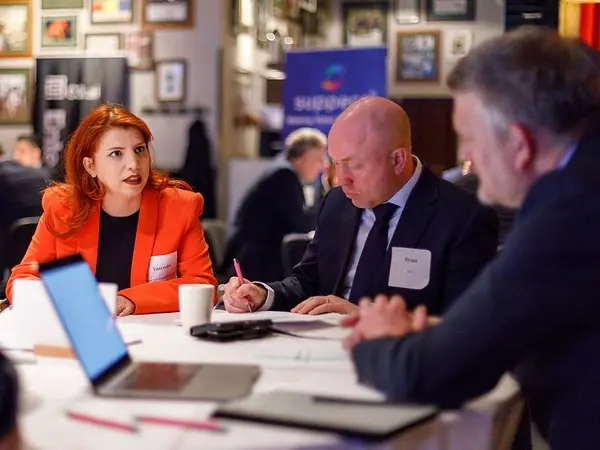
In-person meetings are the flagship format — a full day combining panel discussions, structured roundtables, and one-to-one meetings. Sponsors facilitate roundtables around their area of expertise, working alongside practitioners from comparable organisations who are navigating the same decision. Every sponsor also receives structured one-to-one meeting slots with practitioners who have a relevant context. These meetings happen because the upstream work earned them — not because the format mandated them.
Some stages are deliberately vendor-free. As practitioners move from early orientation into building a concrete plan, independent peer scrutiny matters most and commercial influence should be lowest. BestPractice.Club is transparent about this with practitioners and with sponsors. It is the condition that makes the format trustworthy — and therefore valuable — to both sides.
Once a plan is clear and a practitioner is approaching commitment, solution providers return — to test the plan against commercial reality and surface options that might otherwise not have been considered. By then, the practitioner knows what they need. The conversation is different in quality, not just in timing.
BestPractice.Club does not manufacture intent. It creates the conditions for it to develop — and for you to be present when it does.
BestPractice.Club works best for solution providers whose value is demonstrated through expertise and conversation rather than brand scale or badge association. The format rewards those who genuinely understand the practitioner's decision context and can contribute to it honestly.
You are likely in the right place if your ICP overlaps with senior supply chain and operations leaders making significant capability investment decisions, and your sales cycle is long enough that relationship quality matters more than event-day conversion.
The format tends to work particularly well if:
BestPractice.Club is not optimised for high-volume, low-depth engagement — if broad brand visibility across a large and varied audience is the primary objective, tradeshows and exhibition events will serve that better. The format also works differently from hosted-buyer or speed-dating models where meetings are scheduled to fill a programme slot. If near-term pipeline is the only metric that matters, it is worth a conversation before committing — the format produces genuine engagement and conversion, but it rewards sponsors who are building for the long term.
There is no single commercial model. The right structure depends on your objectives, your ICP, and where your prospects tend to be in their decision journey. Most sponsor relationships start with one of three approaches.
You facilitate a roundtable at an in-person event around a decision challenge where your expertise is most relevant. You receive structured one-to-one meeting slots with practitioners who have a relevant context — allocated through an intake process based on what each person is working on, not scheduled to fill a quota. You also receive post-event decision-stage data for participants in your roundtable. The next in-person event is 12 November 2026 in London.
A structured online discussion around a specific decision challenge, hosted by you and facilitated in the BestPractice.Club format. Typically 60 minutes, the format is a working discussion, not a presentation. Hosts contribute pattern recognition from working across many organisations
For solution providers not ready for event sponsorship, or looking for a lower-commitment way to start, BestPractice.Club can make direct introductions to practitioners with a genuinely relevant context. We don't promise a volume of leads, each introduction is tested for fit first, on both sides, and if it isn't a good match, we won't force it. Practitioners are always told the commercial basis of any introduction we make. This isn't available to every solution provider, suitability depends on genuine relevance to member challenges and fit with how we work.
Many sessions are practitioner-only. Others are hosted by solution providers, in formats structured around a specific decision challenge — working discussions, not presentations or webinars.
Programme themes are set to serve genuine practitioner needs — the topics that consistently surface in member conversations as live decision challenges. Sponsors are matched to the programme according to how their expertise is best positioned to help: a consulting firm facilitating a roundtable, a software vendor contributing pattern recognition from implementations elsewhere, an advisory firm helping practitioners build the internal business case. The form of contribution varies because the value sponsors bring varies.