
A Perspective on decision rights, consensus and the political cost of challenge in Sales and Operations Planning, drawn from a conversation with Brian McLaren, who leads organisational design work at Iter Consulting, a BestPractice.Club partner.
Every S&OP meeting ends the same way. Numbers are reviewed, trade-offs are named, heads nod, the meeting closes on time. Then, a fortnight later, someone in commercial commits stock to a customer that the demand review never agreed to, or a production run gets resequenced without anyone telling the person who built the plan around it. Nobody lied in the room. The plan simply didn't survive the corridor.
That gap between what gets agreed and what actually happens is not a process failure. According to one industry survey, only one in five companies are actually using S&OP as the core decision-making process for their business, with most others stuck running a monthly meeting that produces activity rather than commitment. The process itself is genuinely simple: get a demand file, check whether you can supply it, use inventory and capacity to balance the two. What sits underneath that simplicity, and what most redesigns never touch, is politics and emotion.
There's a reason so many S&OP meetings default to activity over decisions. Consensus isn't the point of S&OP, and he reaches for a line he attributes to Margaret Thatcher to make it: consensus is really just the least offensive option, the one that satisfies nobody and upsets nobody, which is precisely why it produces nothing anyone is actually bound by. S&OP exists to make the call that's good for the business, even when that call upsets somebody.
Chase consensus instead, and everyone gets a vote, every view carries equal weight, and the meeting produces a plan nobody can quite disagree with and nobody is quite committed to either. That instinct to avoid the uncomfortable call is the same one behind most stalled capability investment decisions: the political cost of telling the person leading a programme that they're wrong is high enough that people would rather spend the money and hope.
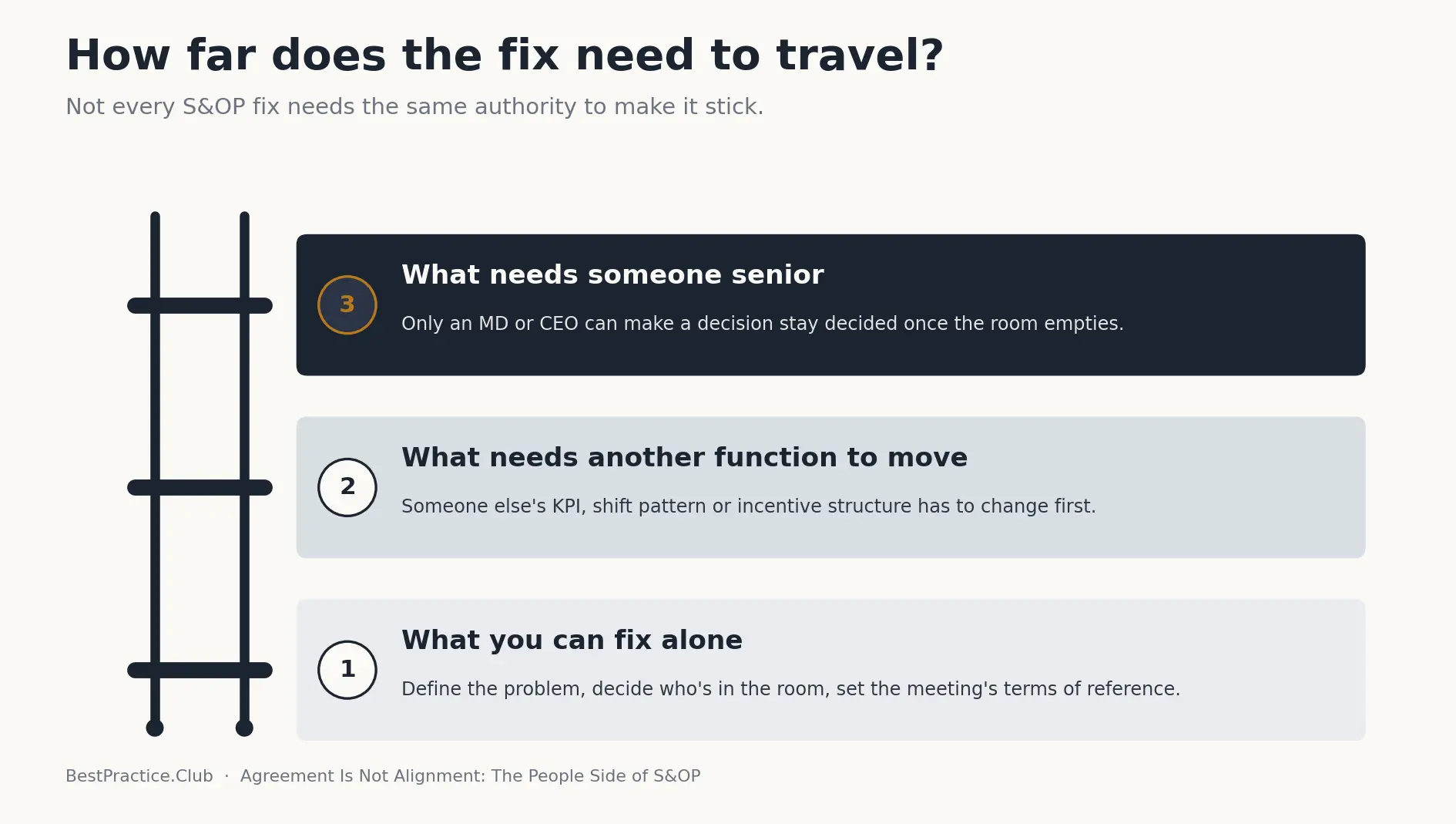
The useful question for a frustrated S&OP lead isn't "what's broken in the process." It's "how far does this fix need to travel." Some things can be changed alone, this week, with no permission required. Others need a different function to move first. And some genuinely need someone more senior to step in, because no amount of good facilitation will substitute for authority the S&OP lead doesn't have. Treating all three as the same problem is why so many redesigns start with the wrong one.
What you can fix alone
Three things sit entirely within an S&OP lead's own gift, whatever the wider organisation looks like.
Start with whether people actually agree on what the business is trying to be. High volume and low cost, or low volume and high cost. Design-to-order, or stock-on-the-shelf. Cash-rich enough to carry risk, or not. None of this requires a mandate. It requires a conversation with finance about what the business can actually afford to be wrong about, and a conversation with operations about how quickly capacity can be turned on and off. An S&OP lead who has these two conversations before the next meeting has done more to fix their process than another redesign workshop would.
The second check sounds like a technology question, but it's really the same people question in disguise. When people are frustrated with how S&OP is performing, the reflex is to conclude the system isn't good enough and a new one would fix it. The instinct to reach for better software before anyone has agreed what problem it's solving is, in one telling analogy, like buying someone a car before they've learned to drive: the model doesn't matter until the driver does, and no amount of horsepower compensates for a team that's never been taught what the process is actually for.
Before recommending new technology, or agreeing to somebody else's request for it, an S&OP lead can ask a single question that needs nobody's permission: has anyone written down, in enough detail to judge a system against it, what the current process actually fails to deliver? Most of the time nobody has, and that gap is worth more diagnostically than the business case built to close it.
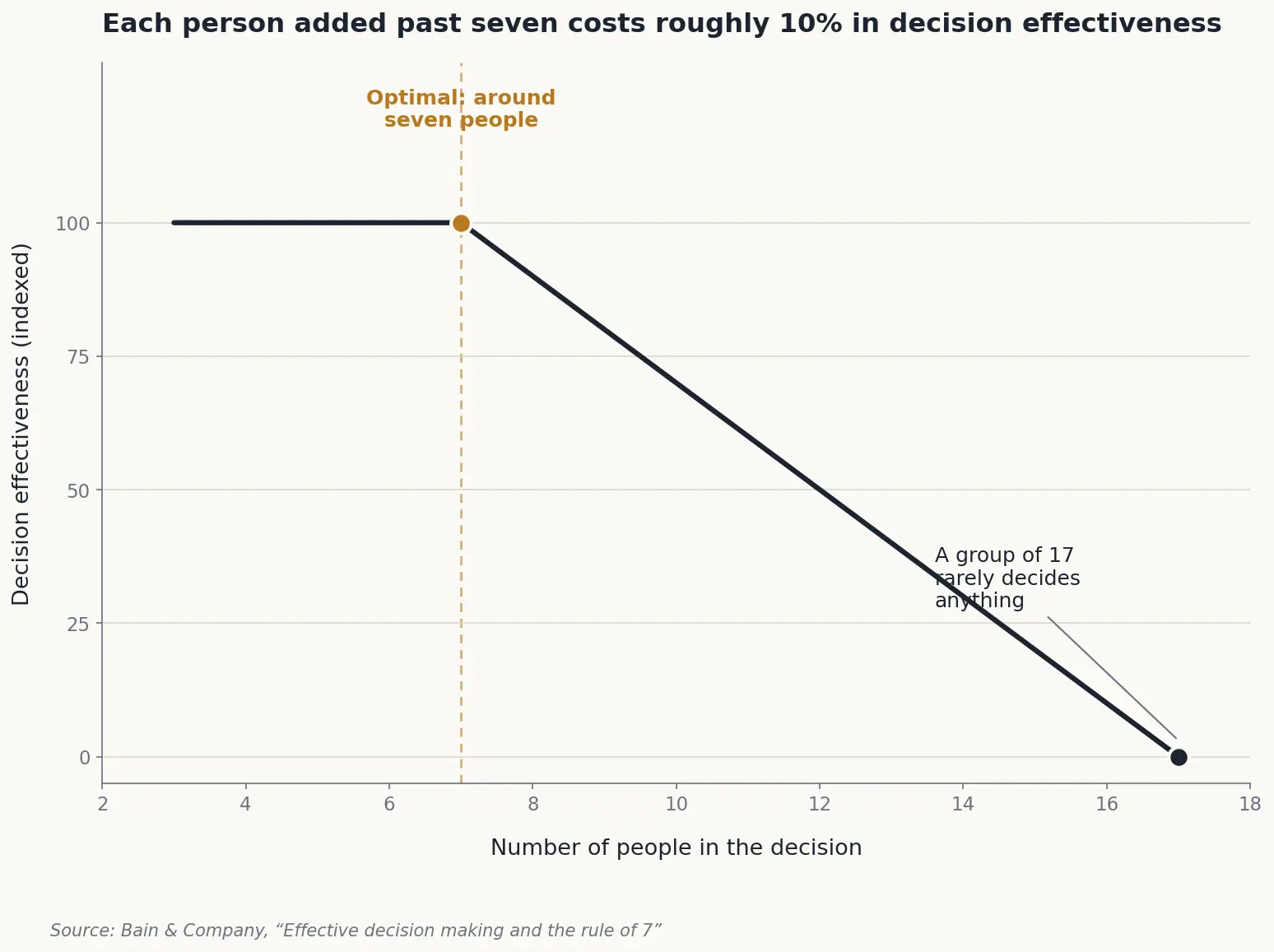
The third is who's in the room. In one pharmaceutical manufacturer, the operations director for the main factory sat in every demand review, bringing forceful, well-informed opinions to a conversation that was meant to produce an unbiased read of unconstrained demand. His opinion mattered. It just didn't belong there: roughly a third of that company's product came from external manufacturers he had no visibility into, so his presence tilted the numbers before finance ever saw them. Removing him from that particular meeting is a design correction anyone running it can make on their own authority. The research on this is blunt: Bain & Company's analysis of decision-making groups found that once a group passes seven people, each additional attendee reduces decision effectiveness by roughly ten per cent, to the point that a group of seventeen rarely decides anything at all (Bain & Company).
Removing that person is politically uncomfortable, which is why framing matters more than mechanics. "You don't need to be here" reads as exclusion. "I can give you time back so you can focus on what you actually need to answer" reads as respect for their time, and gets to the same outcome without triggering the defensiveness that kills the conversation before it starts. The same discipline applies to the meeting's terms of reference: what decision is this meeting actually for, what goes in, what comes out, and who those decisions genuinely involve. A demand review exists to produce an unconstrained view of what the business could sell. Supply-side reality comes later, from a different set of people, deliberately.
None of this needs a sponsor, a project, or anyone's sign-off. It needs an S&OP lead willing to define a problem honestly, have two slightly uncomfortable conversations, and edit an invite list.
What needs another function to move
The next rung up is harder, because it isn't the S&OP lead's decision to make alone. It's someone else's KPI, someone else's shift pattern, someone else's incentive structure, and telling that person their metric is wrong invites exactly the resistance you'd expect.
A plastics manufacturer kept missing its supply plan for guttering, and the instinct was to blame forecasting. The real issue was that commercial's targets treated all guttering as one market, when domestic, commercial and DIY products behaved completely differently and were growing at different rates. Nobody was lying about the numbers; the metric itself couldn't see the pattern. Saying "your forecast is wrong" would have gone nowhere. What worked was posing the scenario as a question: if demand moves by ten per cent, does that apply evenly across the range? Walking commercial through their own numbers let them arrive at the need for finer segmentation themselves, at which point they could see a modest blended uplift was masking a much sharper move in one segment, and that resourcing decisions built on the blended number were wrong in a way that mattered. Fixing it meant commercial redesigning how they segmented and reported, which is not a decision an S&OP lead can make unilaterally.
A separate manufacturer looked like it needed a new machine costing hundreds of thousands of pounds to hit a lead time it kept missing. The actual cause was a night shift with nobody trained to run changeovers, so a 48-hour production run was in fact being split into three separate eight-hour blocks. The gap closed once HR agreed to fund a recruitment and training programme for that shift, and it showed up as higher labour cost rather than the capital spend the original business case was built around.
Both looked like technology or capacity problems from inside supply chain. Both were really about whether the metric, or the workforce, that another function owns had been built to see the thing that mattered. The S&OP lead can't fix commercial's segmentation or manufacturing's shift coverage directly, but can surface the frustration accurately enough that the function with the authority to act sees the case for itself. That's a different skill from the first rung: less about editing a meeting, more about asking a scenario-based question precisely enough that someone else discovers the answer without being told it.
What needs someone senior
The last tier isn't about adding more senior people to the meeting. It's about what they're there for.
The corridor conversation that starts "did you actually agree with that plan" is what turns whoever's having it into the problem, because the alternative to accepting a decision you contributed to isn't working around it without saying so. It's escalating the disagreement back into the process that was designed to resolve it. This is agreement is not alignment in its most literal form: a room full of people who said yes, followed by individual behaviour that suggests several of them didn't mean it. Bain & Company's research on decision-focused meetings identifies exactly this pattern, reopening decisions after they've been made, as one of the leading causes of meeting proliferation and organisational drag, and the fix it recommends is the same one in practice here: assign the decision role explicitly, and hold people to having played it (Bain & Company).
Enforcing that isn't the S&OP lead's job. It sits with the managing director or CEO, playing a role closer to a regimental sergeant major or a chief whip than a decision-maker in the room itself, and not because they need to be present every week. One managing director was told: you have an open invite, but you're not there to contribute, you're there to check whether the culture and behaviours you want are actually showing up. Are decisions being made. Are the right people in the room. Is anyone undermining what was agreed once they're back at their desk. That's a different job from sitting in the room every week, and it's the one thing an S&OP lead genuinely can't do for themselves: someone has to hold people to what they agreed to, once the meeting is over.
The same senior intervention applies, less obviously, to who gets asked to run S&OP in the first place. The strongest S&OP leads aren't administrators confirming a meeting happened and a report went out. They're closer to a trusted chief of staff, or the person in a regiment everyone defers to instinctively because they've seen enough to be trusted: someone with the standing to question a decision without it reading as a challenge. Treating the role as purely administrative, made by whoever decided it didn't need that seniority, is one of the more common, and more fixable, reasons the whole thing stalls. It connects to a wider and slower-moving problem too: supply chain doesn't have the professional recognition that lets a leader ask for outside help without it reading as an admission of weakness, the way a tennis player hiring a coach, or an executive appointing a non-exec director, reads as strength rather than deficiency. That's not something an individual S&OP lead fixes. It's a cultural shift that only takes hold when someone senior treats external challenge as normal practice rather than a last resort.
Before your next S&OP meeting
None of this is a case for waiting on permission before doing anything. The first rung, understanding real constraints and getting the right people in the room, is available today, to anyone running the process, regardless of title. What changes further up the ladder isn't the diagnosis. It's who has to act on it. A leader stuck at "we need to redesign the whole process" is often describing a problem with the second or third rung while reaching for a first-rung fix, because redesigning the process is the visible, fundable, exciting option, and admitting the real constraint sits in someone else's KPI or a director's need to be in a room they don't belong in is neither of those things.
None of this moves as fast as a redesign slide would suggest, and it's worth saying plainly before anyone starts. One rule of thumb, passed down from an early coach: it takes six to nine S&OP cycles just to become competent at running the process this way, and closer to three years before the difference is genuinely structural. The first visible results tend to show up around six months in, which is long enough to test patience and short enough to be worth starting now rather than waiting for a calmer quarter that won't arrive.
This is the same dynamic that sits behind most stalled capability investment decisions, not just S&OP redesigns: the person leading the initiative can see what needs to change, and the political and social cost of saying so plainly, particularly to someone senior, is high enough that the case gets built around the visible symptom instead. That's the decision gap in a specific, weekly form.
Read more on stakeholder alignment and organisational readiness.
FAQ
Does fixing S&OP start with the process or the people? Neither, on its own. It starts with whether everyone in the room agrees what the business is trying to be, including its appetite for risk and cash. Redesigning process steps without that agreement in place produces a cleaner meeting that still can't make decisions.
What can an S&OP lead change without asking anyone's permission? Three things: whether the current process's failures are actually written down before anyone shops for a replacement, who's invited, and what each meeting's terms of reference actually are. All three sit within the S&OP lead's own authority, and all three affect whether decisions made in the room hold once the room empties.
Why does a decision that felt agreed in the meeting fall apart within weeks? Because agreement inside the room and alignment outside it are different things, and only one of them is visible to whoever's running the meeting. Without someone senior willing to hold people to what they agreed to, reopening a decision costs nothing.
When does S&OP actually need the CEO or MD involved? Not to adjudicate demand numbers. Their role is to make clear that decisions made in the process stay made, and to check, occasionally rather than constantly, that the culture in the room matches what the business says it values.
How long does it take to see results from fixing S&OP this way? Roughly six months for the first visible change, six to nine cycles to become genuinely competent at running it, and closer to three years before the shift is structural rather than a good quarter.
This piece draws on a conversation with Brian McLaren of Iter Consulting, a BestPractice.Club partner. If this is the decision you're actually sitting in right now, Iter is hosting a small group of supply chain and planning leaders to work through it directly on 22 October, online: What's Limiting Your S&OP? It's Not the Process. It's the People.
Also, download The S&OP People Playbook.