
A recent discussion on data foundations hosted by Andy Devlin opened with his reflections on how the supply chain leadership role has changed.
“We used to give advice on how to run supply chains,” he said. “Now we’re expected to be technologists, data management consultants.”
That observation set the direction for the session. What followed was not a debate about which platform to choose or whether AI has potential. It was a more practical conversation about what sits underneath those ambitions.
Several contributors described being asked to sponsor automation or AI initiatives within supply chain. In each case, the outcome depended on data distributed across multiple systems and functions.
One example involved a regulatory automation use case that initially appeared relatively contained. Once mapped properly, it required 127 data fields across 13 systems, involving ten functional groups. Some inputs were structured and governed within enterprise systems. Others were maintained in spreadsheets, collaboration tools or email exchanges.
The issue was not the absence of data. It was that ownership and control were dispersed.
This experience resonated across the group. In most organisations, data has evolved around functional requirements. Commercial teams manage sales history and forecast inputs. Finance defines reporting logic. Manufacturing owns production parameters. Logistics interfaces with carriers and partners. IT governs infrastructure layers that may differ by geography. Each domain has its own standards and incentives.
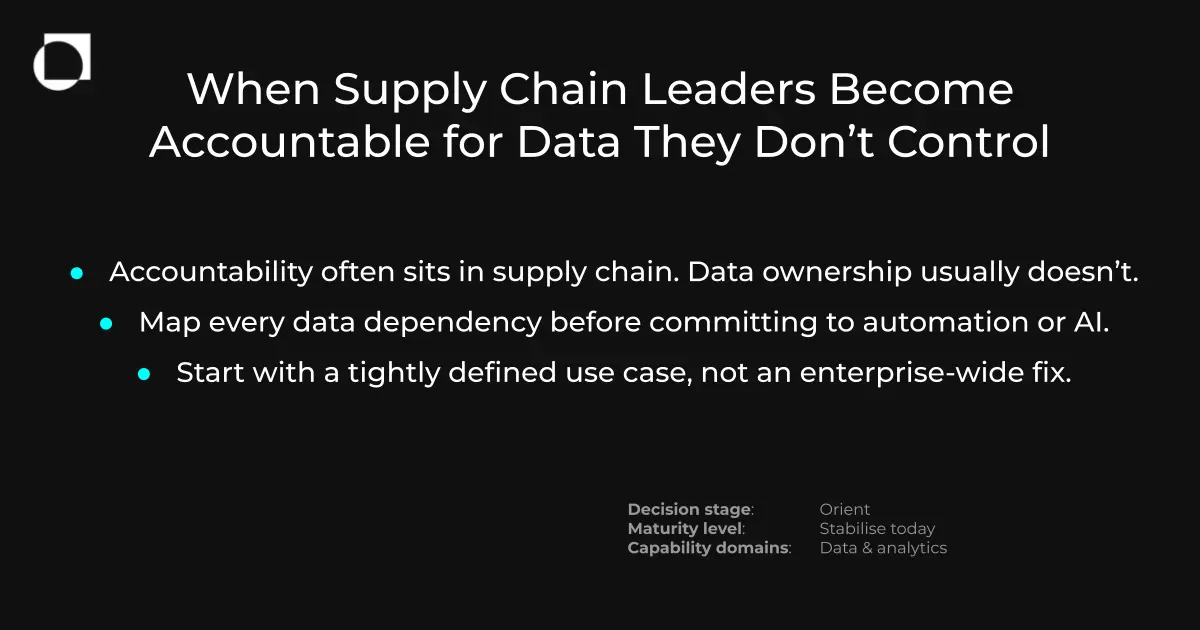
When a cross-functional digital initiative is introduced, someone is made accountable for delivering the outcome. That accountability does not automatically bring authority over all the required inputs.
Andy described the situation succinctly:
“You find yourself owning a lot of stuff that you don’t own.”
From the discussion, several practical learning points emerge for leaders facing similar challenges.
1. Map the full data dependency before committing to the solution.
Before evaluating platforms or promising automation gains, identify the complete set of data elements involved in the use case. Include where each element resides, how it is maintained and who has authority over it. Assumptions about system boundaries tend to underestimate real complexity.
2. Distinguish between accountability and control.
If you are accountable for a digital outcome but do not control the majority of its data inputs, progress will depend on cross-functional alignment. That may require explicit executive sponsorship rather than informal coordination. Recognising this early can prevent delivery risk being absorbed into a single function.
3. Define scope deliberately.
One contributor described improving digital shipment visibility from a very low starting point by narrowing the initiative to a defined subset of flows. Progress was made by aligning ownership and governance within that boundary. Attempting to harmonise all data globally at the outset would have delayed delivery significantly.
4. Clarify governance before layering intelligence.
Another participant described spending several months defining ownership of critical data fields across logistics, planning and manufacturing before implementing automation. That work reduced ambiguity later in the programme. Advanced tools depend on stable definitions and agreed responsibilities.
5. Be explicit about the type of outcome being pursued.
Executional visibility — such as tracking shipments or orders — relies primarily on integrating operational systems and improving timeliness. Mitigation-oriented intelligence — such as anticipating shortages or regulatory risk — usually requires broader data consistency across functions. The second category expands both scope and dependency.
The discussion did not question the value of AI. It did question sequencing. Advanced analytics can amplify both strengths and weaknesses in existing data structures. If ownership, definitions and authority are unclear, automation does not remove that complexity.
For a leader at the orient stage of a similar initiative, the immediate task may not be technology selection. It may be clarifying the relationship between ambition, scope and data control.
Digital accountability is now part of the supply chain remit. Aligning that accountability with data reality appears to be one of the central challenges.